
Smuggling AI into a national exam room: A South Korean candidate used a pinhole camera and concealed earpiece to score 159/160 before turning himself in

- Han Won-seok reportedly scored 159 out of 160 using AI assistance
- A miniature camera secretly captured questions inside South Korea’s examination hall
- A concealed earpiece delivered answers generated by artificial intelligence
Artificial intelligence is creating new opportunities across education, professional training, and competitive examinations, but its misuse is becoming increasingly difficult to detect.
A recentcheating scandal in South Korea has exposed how candidates can combine miniature surveillance equipment, smartphones, and AI assistance to manipulate high-stakes assessments.
A 34-year-old man reportedly exploited this combination to achieve an almost perfect examination result before eventually surrendering through legal representation.
A concealed system helped produce an extraordinary examination score
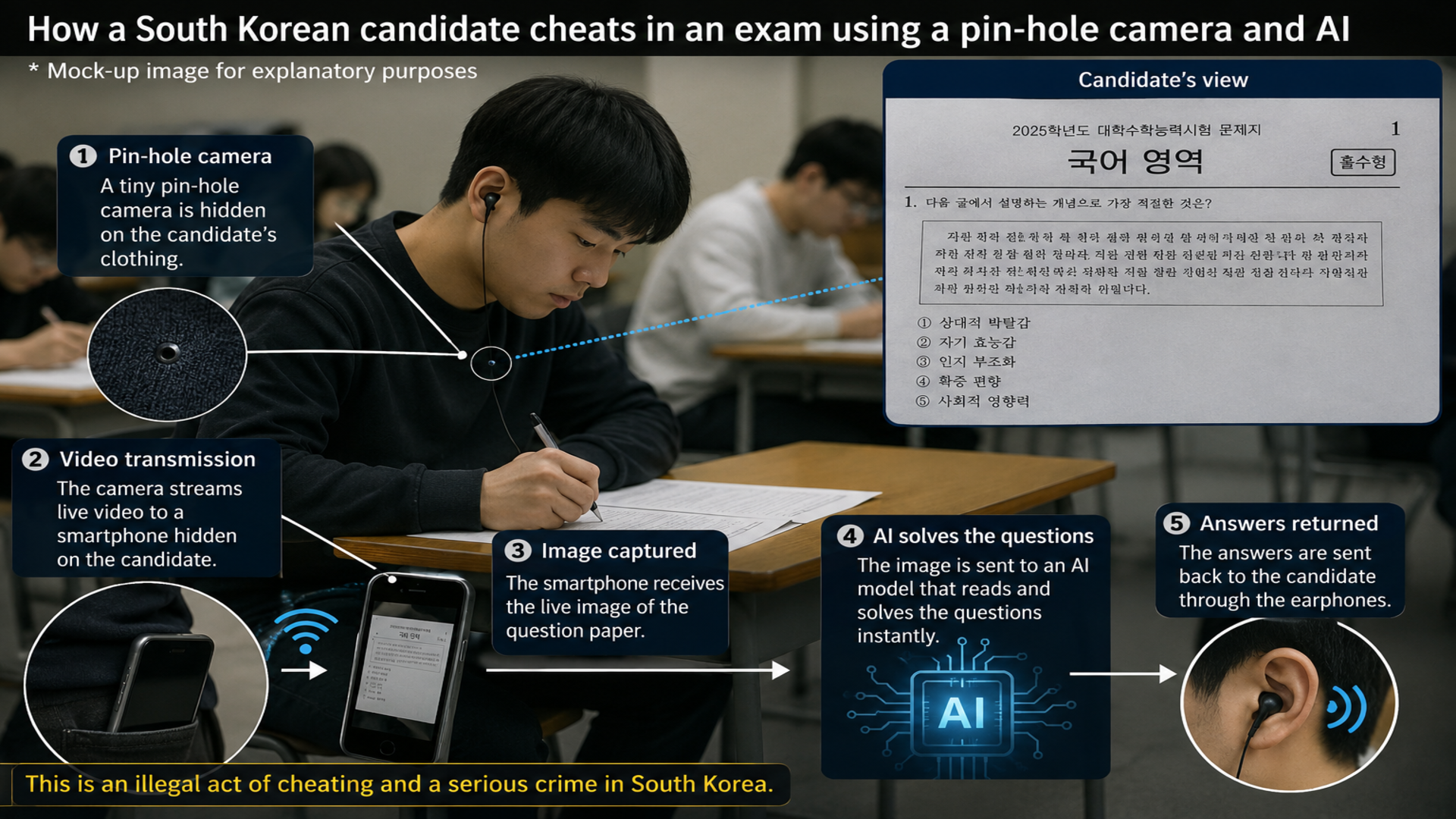
The scandal covered both stages of South Korea’s 63rd certified tax accountant qualification examination and the preliminary stage of its certified public accountant examination.
Han Won-seok reportedly used a miniature camera concealed in his clothing to capture examination questions without attracting attention from invigilators.
The images were transmitted through a smartphone to an artificial intelligence system, which generated answers that reached him through a concealed listening device.
According to Yonhap, the candidate explained his method during a public confession released through his attorney’s YouTube channel.
“I cheated by taking pictures of the questions with a miniature camera, sending them to AI, and checking the answers on a smartphone,” he said.
The equipment reportedly allowed him to obtain answers without requiring another person to communicate directly with him.
However, available reports have not identified the camera manufacturer, the AI tools, or the specific smartphone model involved.
Investigators have also not disclosed how the photographs reached the artificial intelligence service or how responses were transferred into his earpiece.
The candidate reportedly answered 159 of the 160 questions correctly in the first stage of the tax accountant examination.
That result represents approximately 99.4% accuracy, although available reporting does not independently establish the precise circumstances behind his performance.
His unusually high score attracted attention as details surrounding the examination emerged publicly.
The candidate subsequently submitted a written statement describing his conduct to the Seoul Metropolitan Police Agency.
Explaining his decision, he said, “I wrote down everything I did in a statement of voluntary surrender and submitted it to the Seoul Metropolitan Police Agency.”
Police investigate the fraud
The Seoul Metropolitan Police Agency has received the candidate’s written confession through his attorney and assigned investigators to examine the case.
However, authorities have not announced any charges, prosecution or judicial decision, leaving the legal outcome unresolved.
Investigators may examine electronic devices, account records and examination hall footage to establish whether the candidate’s account matches available technical evidence.
The incident also raises practical difficulties for professional examination administrators because increasingly compact electronic equipment can be difficult to identify during routine inspections.
Traditional restrictions on smartphones and communication devices may not adequately address equipment designed specifically for discreet image capture and wireless communication.
Professional licensing bodies could consequently face pressure to strengthen physical screening and reconsider how they assess candidates’ competence.
Via Shanyanggm